
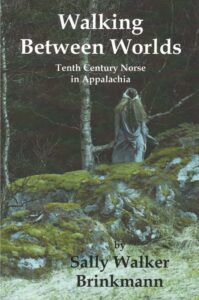
Walking Between Worlds is a magical story that blends Appalachian lore with ancient Norse mythology, centered on the mysterious Larson family and their ability to move across time and space. The story begins with Lucia, a young woman who appears in 1830s Virginia under impossible circumstances, speaking Old Norse and giving birth on the night of her arrival. She marries the eldest Larson son and her presence marks the beginning of a family line with the ability to “walk between worlds.” This heritage fades, surviving only in fragments of memory and the “Ballad of Lucia Larson.”
The story begins with Finn Hanson, a troubled Afgan war vet returning to his West Virginia home, and Emma Larson, a young woman who inherits her grandmother’s house nearby. Finn struggles with trauma, guilt, and a drinking problem, while Emma seeks stability after personal setbacks. Their lives intersect with the lingering mystery of the Larson legacy. Emma experiences vivid dreams and discovers a hidden woodland clearing known as the “Cold Place,” where she witnesses ritualistic gatherings of folk who appear to be Norse. They speak an ancient language, perform ceremonies led by a “Hexa” (wise woman), and seem to exist outside normal time. In her dreams, Emma sees a small, blond boy, Halvard, who is mistreated by his father, the Yarl, hunted by the Vonder Nom (evil witch), but protected by the Hexa. Emma uncovers physical evidence—artifacts, writings, and family heirlooms—that suggest these are not reenactors, but visitors from another era. Her research, aided by an anthropologist friend, deepens the mystery. The clearing contains plant life and environmental conditions inconsistent with the region, reinforcing the idea of a portal between worlds.
Meanwhile, Finn unknowingly encounters the same forces. His experiences are more violent, marked by physical confrontations and supernatural attacks, blurring the line between trauma-induced hallucination and real, otherworldly danger. His family’s inherited knowledge of runes and the Goddess Eir’s protection rituals hint that he, too, may be tied to the same ancient lineage as the Larsons. When little Halvard is saved from harm by the Hexa and enters the modern world, the story explores themes of heritage, belief, and identity. Is time a fixed concept? Is the past ever truly gone, or does it continue to live alongside the present, just beyond the veil? Now, these Norse descendants must confront their extraordinary inheritance foretold in the “Ballad of Lucia Larson.”